This guide hands you the metrics, strategies, tools, and step-by-step framework to build that system.
Call Center Performance Management is the ongoing process of measuring, analyzing, and improving how a call center and its agents perform against defined goals. It connects three things most teams keep in separate silos:
- the numbers (call metrics and KPIs),
- the people (agent coaching and development), and
- the outcomes (customer satisfaction and cost per contact).
Think of it as the operating system for your floor. Instead of reacting to last month’s report, you continuously track performance, spot drift early, coach against it, and prove the impact. The goal isn’t surveillance but clarity. When agents understand exactly what “good” looks like and get real-time feedback to hit it, both call center agent productivity and morale climb together.
You can’t manage what you don’t measure, and measuring everything is just noise. Effective call center KPI management means tracking the handful of numbers that actually predict customer and business outcomes. Here are the best KPIs to track in a call center:
Customer Experience Metrics
- First Call Resolution (FCR): The share of customer issues fully sorted out on the very first contact, with no follow-up needed. Top performers usually sit in the 75%–85% range, and the higher it climbs, the fewer callbacks you field and the more satisfied customers stay.
- Customer Satisfaction Score (CSAT): A quick post-interaction rating that captures how a customer felt about one specific exchange, usually collected through a short survey right after the call.
- Net Promoter Score (NPS): A broader loyalty gauge that asks whether a customer would actually stake their own name on recommending you to others.
- Customer Effort Score (CES): A measure of how hard the customer had to work to get their problem solved and low effort often does more for retention than trying to “delight” them.
Speed & Efficiency Metrics
- Average Handle Time (AHT): The mean length of a full interaction — talk time, hold time, and the wrap-up work afterward — spread across the total number of calls.
- Average Speed of Answer (ASA): How long, on average, a caller waits in the queue before a live agent actually picks up.
- Call Abandonment Rate: The proportion of callers who give up and disconnect before ever reaching an agent.
- Service Level: The percentage of calls answered inside a set time target. A widely used benchmark is picking up 80% of calls within 20 seconds.
Workforce & Operational Metrics
- Schedule Adherence: How faithfully agents stick to their rostered shifts, breaks, and login windows, with 90%–95% generally considered a healthy band.
- Occupancy Rate: Of the hours agents are clocked in, the slice actually spent handling live contacts rather than sitting idle between calls.
- Cost Per Call: Your total operational spend divided by the number of calls handled.
Track these weekly, segment them by agent and queue, and the story behind your performance stops hiding.
Metrics tell you where you stand, but strategy is how you climb. If you’re wondering how to improve call center agent performance without simply demanding “do more,” these moves compound.
- Set unmistakable goals: Every agent should be able to name their targets and explain why those targets matter to the business.
- Coach continuously from real calls: Build feedback into the daily rhythm using recordings of actual interactions. A steady stream of small corrections beats a single make-or-break review at year’s end.
- Invest in onboarding and skill-building: Develop your people on an ongoing basis, so they resolve issues themselves instead of passing them up the chain.
- Benchmark against the best: Use call center benchmarking to measure your figures against both industry norms and your own strongest agents, then work deliberately to shrink the gap between your typical result and your best one.
- Strip out the friction: Clear the clunky scripts, slow systems, and broken handoffs that quietly drag performance down.
Spreadsheets and end-of-day reports quietly lie to you, and by the time you read them, the moment to act has already passed. Modern Call Center Performance Management runs on software that shows what’s happening now. The right stack usually blends your ACD/telephony, a quality-monitoring tool, and workforce management software that forecasts volume, builds schedules, and tracks adherence in real time.
This is where TeamTrace fits for call centers. It pulls productivity monitoring, time and attendance, and resource management into one screen, so your call center KPI management rests on what agents are actually doing. You see live availability, activity, adherence, and utilization, then act before small dips compound into missed service levels. See how it works on the employee productivity monitoring side of the platform.
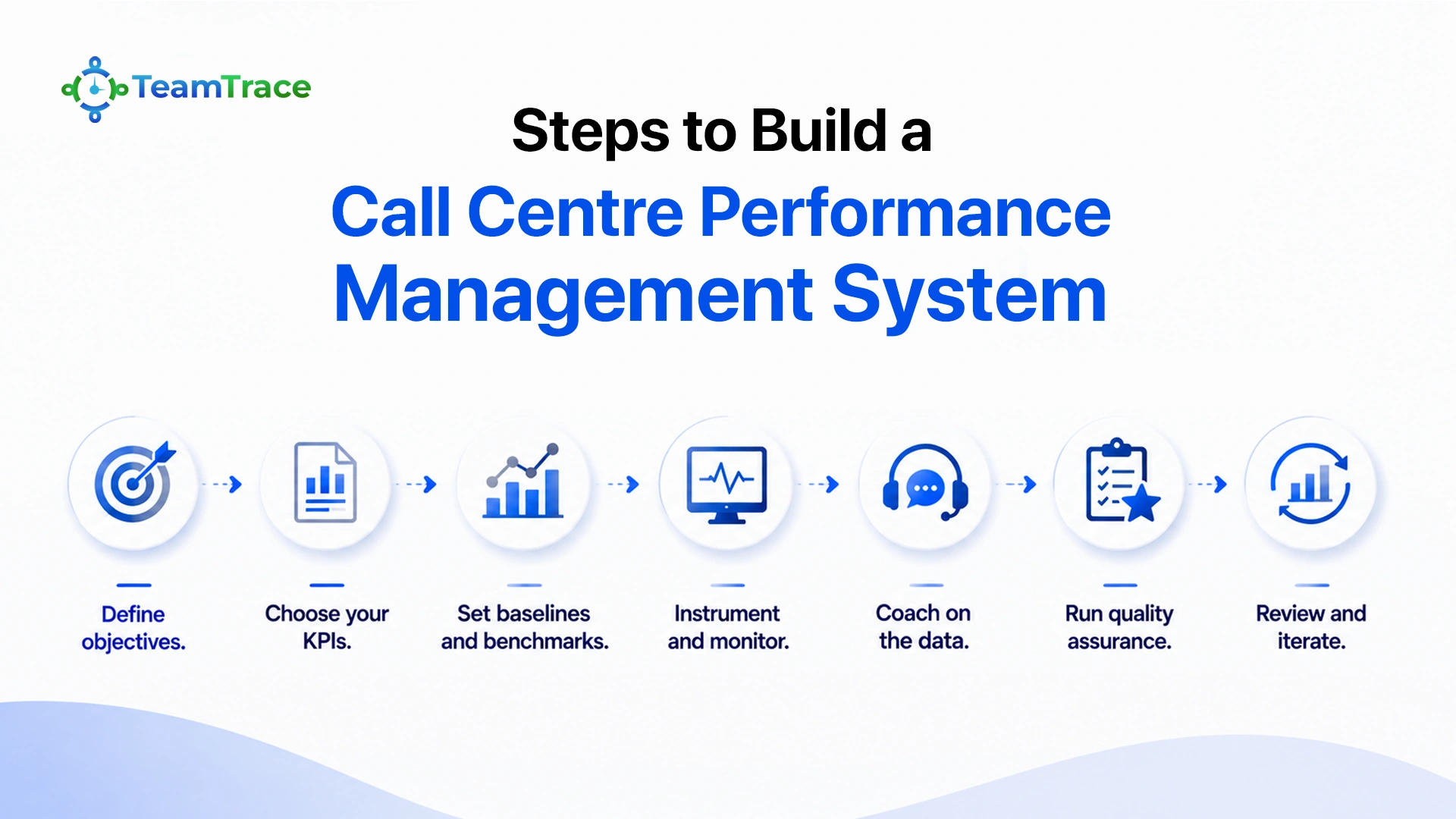
A tool alone isn’t a system. Here’s a simple call center performance management framework you can stand up in weeks:
- Define objectives. Tie center goals to business outcomes — retention, cost per contact, CSAT.
- Choose your KPIs. Pick 5–7 metrics that map to those goals and ignore vanity numbers.
- Set baselines and benchmarks. Use call center benchmarking to know what “good” is before you chase it.
- Instrument and monitor. Deploy tools that capture data automatically and in real time.
- Coach on the data. Turn insights into weekly, personalized feedback for each agent.
- Run quality assurance. Score interactions consistently against a clear and shared rubric.
- Review and iterate. Hold a weekly rhythm to spot trends and adjust before they cost you.
Follow this loop, and Call Center Performance Management stops being a report and becomes a habit the whole floor can feel.
Even sharp leaders sabotage their own results, and most Call Center Performance Management failures trace back to five avoidable habits.
- Drowning in metrics: The first mistake is tracking everything that moves. When 30 KPIs sit on a dashboard, none of them actually drive a decision. Your team stares at a wall of numbers while no single figure feels urgent, and the report becomes something you glance at rather than act on. A tight set of five to seven metrics tied to real outcomes will always beat an exhaustive one nobody uses.
- Worshiping speed: The second is chasing handle time above all else. Squeeze AHT hard enough, and you’ll watch agents rush customers off the line, skip proper resolution, and quietly tank your FCR and CSAT in the process. Faster calls that don’t solve the problem just come back as repeat calls tomorrow, so you pay for the same issue twice while the customer’s patience runs out.
- Coaching only the strugglers: The third is pouring all your development time into the bottom performers while the middle 60% of your team goes untouched. That vast middle is exactly where the biggest and cheapest gains hide. Nudge a dozen average agents up a few points each, and the aggregate lift dwarfs anything you’ll squeeze out of rescuing a handful of laggards.
- Weaponizing quality assurance: The fourth is running call center quality assurance as a “gotcha” audit instead of a coaching tool. The moment agents feel scored to be punished rather than helped, trust evaporates overnight. They start gaming the scorecard, hiding mistakes, and disengaging from feedback altogether. QA should feel like a coach reviewing game tape, not a manager building a case against them.
- Reviewing too infrequently: The fifth is treating performance as a monthly ritual. By the time a problem surfaces in a month-end report, it has already been costing you for weeks — lost customers, frustrated agents, blown service levels you can no longer recover. Real performance management runs on a weekly, sometimes daily, rhythm, so you catch the dip while it’s still small enough to fix.
Fix these, and half your performance battles vanish before they begin.
Keep this list where your team can see it:
- Track a focused set of 5–7 KPIs, reviewed weekly.
- Balance efficiency metrics (AHT) with experience metrics (FCR, CSAT).
- Coach continuously with real call examples.
- Make QA scoring transparent and consistent for every agent.
- Benchmark against industry data and your own top performers.
- Use real-time workforce management software to match staffing to demand.
- Involve agents in goal-setting so targets feel fair.
- Tie every single metric back to a customer or business outcome.
Great call centers are the ones that turn data into daily decisions. That’s the whole promise of Call Center Performance Management, where you can see the performance clearly, coach against it continuously, and prove the impact in numbers the business actually cares about. Start with a focused set of KPIs, build a simple call center performance management framework, benchmark honestly, and give agents real-time feedback they can act on. Do that week after week, and you’ll cut costs, lift satisfaction, and keep your best people. Ready to see your team’s real performance in a single live view? Start a free 7-day TeamTrace trial.

 Saswata