
 TeamTrace



Wondering how to assess remote workers’ productivity? The truth is, it takes more than just chasing surface-level numbers.
Honestly, if you’re still measuring productivity by how long someone appears “active,” you might as well use a sundial to track project deadlines. It’s 2025… remote work has evolved, and so must your metrics.
With time zones stretched, hybrid work structures being adopted, and distractions just a tab away, the old rules no longer apply. That’s because it’s all about outcomes, accountability, and clarity now.
This blog breaks down the rules of measuring remote workers’ productivity so that you can interpret remote workforce analytics with precision.
It’s time to lead smarter, act faster, and build a high-performing remote team that delivers.
As you already know, remote work is now the lynchpin of high-performing businesses. But in remote environments, poor visibility is a liability.
If you don’t have clarity regarding the key productivity metrics for remote workers, you risk:
Physical presence used to equal performance in the past. But that doesn’t hold true anymore. Leaders need to focus on output over hours, clarity over control, and accountability over attendance.
Measuring productivity in remote setups helps you:
While many teams report significant productivity gains, with 78% noting that their remote teams are smashing their goals and 66% observing increased productivity, the shift has also revealed underlying issues that require careful management. Let’s have a look at the core productivity hurdles that remote employees encounter and understand how to track remote employee output.
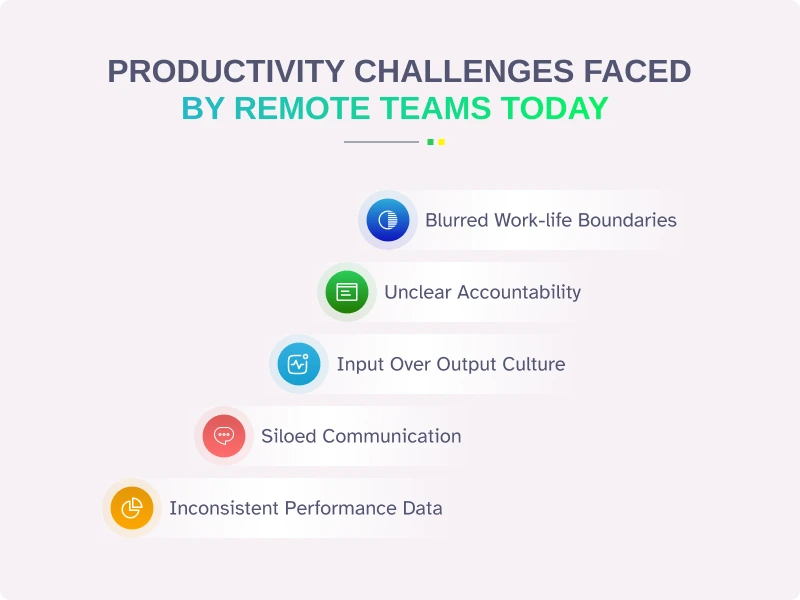
Without clear work hours or output tracking, many remote employees overwork to “prove” they’re being productive. This leads to burnout, inconsistent performance, and silent disengagement. That’s when a productivity tool steps in to help set healthy, measurable boundaries.
Distributed teams often struggle with task ownership and responsibility. When deliverables slip, the “I thought someone else was handling it” trap is common. Remote workforce analytics platforms that log work, effort, and timelines create an accountability-first culture. And that’s what aids managers to measure remote workers’ productivity effortlessly in the current era.
When you don’t measure what truly matters (that is, results), it’s tempting to over-monitor activity. Productivity tools shift the focus to outcome-based tracking, freeing teams from surveillance and empowering them with autonomy. No wonder why nearly half of companies (46%) have introduced or increased the use of productivity tracking tool in the past year.
Remote doesn’t mean isolated… but without clear dashboards and task transparency, silos form fast. Productivity tracking tools integrate updates across tools and departments, enabling smoother collaboration without endless check-ins. In that way, these tools help you thwart this challenge hassle-free.
Without structured insights into daily performance, reviews become subjective and unfair. Remote workers may feel overlooked or undervalued. Intelligent productivity tools offer factual, unbiased data for fair evaluations, and that’s what makes these platforms indispensable.
You can master remote workforce productivity management by implementing the following strategies. Let’s unveil what these are:
If you don’t establish clear goals and align them with company objectives, ensuring remote success may prove to be arduous.
The reason is obvious. Vague instructions lead to missed deadlines, confusion, and duplicated work.
For example, instead of saying “Design client proposals,” emphasize on the particularities by relaying out: “Deliver three customized proposal templates for the X campaign by Thursday, including visuals and costing.”
Productivity tracking tools such as TeamTrace help managers set, track, and evaluate each deliverable, backed by real-time dashboards that reflect progress and blockers.
Constant hovering and manual check-ins sap motivation and kill trust. It signals a lack of confidence and drains productivity. The reason is simple. Growth rarely finds its footing in stifling conditions. Bringing in flexibility is, therefore, a must.
As per a Zoom survey, 43% of all respondents believe that flexible work is no longer a perk. It is a basic expectation. In fact, 70% of them would consider leaving their current job for a more flexible working environment in the future.
So, what can you do?
Always remember that trust is irreplaceable. Use productivity tracking software for narrowing down on outcomes instead of analyzing details of your employee’s work. That’s because, the first step towards creating productive work culture lies in nurturing trust. Only then will your employees feel engaged at work.
People don’t produce their best work in the same 9–5 window. Productivity peaks vary by individual.
Forcing a 9–5 schedule in a remote world stifles high performers who may work best at night, early mornings, or in split blocks.
Here’s how you can do it right:
If your marketing designer works from 11 pm to 2 am and still hits deadlines, let them. Use productivity tools to track performance without enforcing a rigid schedule.
Silence is dangerous in remote teams. Employees don’t raise blockers early. Managers assume things are fine until it’s too late.
For instance, a remote engineer spends 5 hours solving a problem that already had a known fix — just poorly documented. With regular feedback loops and shared visibility, this could’ve been flagged and avoided.
In remote setups, it’s easy for work hours to bleed into personal time. Employees logging higher number of hours a week may seem productive on the surface. However, under the hood, they’re often fatigued, disengaged, or teetering on burnout.
Silent burnout doesn’t announce itself. It just shows up in missed deadlines, low output, rising attrition, and mental health decline. The most common hurdles faced by remote workforce include:
For healthier output, remote teams can set boundaries in the following ways:
Traditional productivity metrics no longer serve their purpose. Rather, these actively undermine real performance. It’s time that organizations pivot their performance evaluation around the factors that truly matter. Let’s uncover what these are:
One of the most persistent myths of productivity, especially in remote settings, is that the number of hours worked directly correlates with the amount of value delivered. In reality, “hours logged” is a deeply flawed metric that fails to account for how people work best in distributed environments.
Remote workers often operate across time zones, in different bursts of energy, and in asynchronous workflows. Measuring productivity based on how long someone appears online penalizes those who may work more efficiently or during non-traditional hours. Further, it also encourages performative behavior like staying logged in unnecessarily or attending unproductive meetings just to be seen.
In contrast, outcome-based performance metrics focus on tangible deliverables, goal achievement, and actual value creation. Instead of monitoring when someone works, organizations should track what they accomplish.
For instance, platforms such as TeamTrace aid in decoding remote workforce analytics and help define and track key deliverables, while frameworks like OKRs (Objectives and Key Results) help align individual output with broader team and business objectives. This approach respects autonomy, supports flexibility, and ensures accountability without micromanagement.
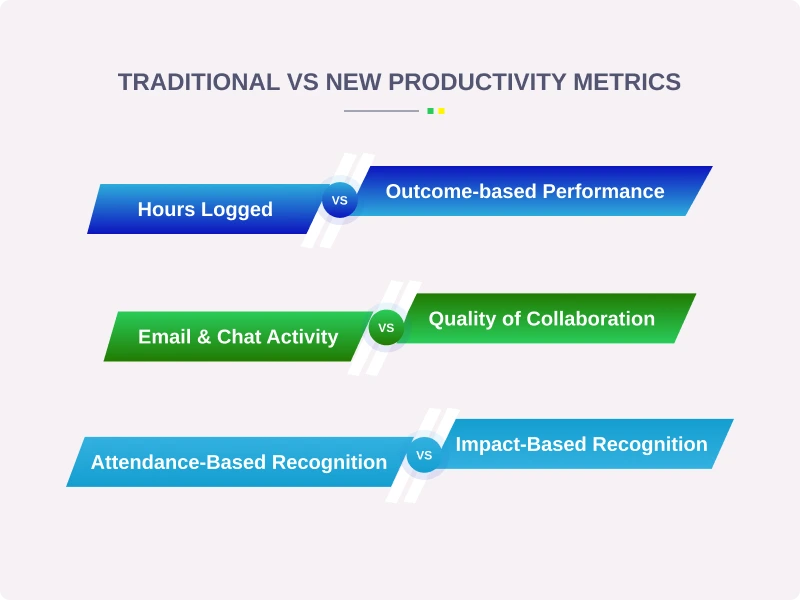
For years, the volume of emails sent, Slack messages exchanged, or meetings attended was considered a rough proxy for engagement and collaboration. But in the modern remote ecosystem, this metric is not only outdated—it’s counterproductive.
High communication volume can be a red flag for inefficiency, unclear workflows, or poor task distribution. In remote work, quality trumps quantity when it comes to collaboration.
True productivity comes from purposeful, effective communication that drives decision-making and problem-solving. Teams should instead assess the quality of collaboration, looking at contributions to shared documents, the impact of async updates, clarity of documentation, and feedback from peers and cross-functional partners.
Evaluating collaboration quality encourages intentional interactions, clearer communication, and stronger team alignment without drowning in noise.
In many legacy workplaces, recognition was tied to visibility… how often you showed up to meetings, how early you logged in, or how often your name came up in a Slack thread.
On the contrary, in remote-first cultures, especially in globally distributed teams, attendance doesn’t equal impact. Recognizing productivity based on visibility alone creates inequity, discourages flexibility, and often overlooks the quiet high-performers who drive real results behind the scenes.
Modern organizations are instead implementing impact-based recognition systems that celebrate meaningful contributions to business goals, innovation, or team success. This might take the form of public kudos channels, peer-nominated awards, or quarterly recognition tied to project milestones.
By aligning recognition with value delivered, organizations can foster a culture of appreciation and motivation. This approach also supports a healthier work environment by allowing employees to focus on outcomes rather than appearances.
Nowadays, businesses are increasingly embracing holistic, nuanced metrics that reflect the true effectiveness, output, and engagement of remote employees. These new metrics prioritize outcomes, quality, and personal accountability — elements that matter most in decentralized, trust-based work cultures.
Let’s unfurl four key productivity metrics for remote workers that are gaining traction this year:
Task Completion Rate is one of the most straightforward yet powerful indicators of remote productivity. It measures how consistently an employee or team delivers assigned tasks on time, relative to expected timelines. This metric focuses on execution and reliability that are in distributed environments where team members may be working asynchronously and independently.
A high task completion rate signals that employees are organized, capable of self-managing their workload, and following through on commitments. More importantly, this metric avoids micromanagement by focusing on deliverables rather than activity.
To implement it effectively, organizations should define clear, actionable tasks within project management and productivity tracking tools like TeamTrace, complete with deadlines and priorities.
Automated dashboards can then track completion trends, overdue items, and blockers. However, it’s crucial to pair this metric with context. Understanding why tasks weren’t completed, if deadlines were realistic, and whether priorities shifted, are essential.
When used correctly, Task Completion Rate serves as a lens into team health, capacity planning, and project alignment.
Measuring productivity without assessing quality is like tracking speed without direction. Yes, it can be utterly misleading.
In 2025, quality of work delivered is emerging as a cornerstone metric, especially in knowledge and creative work where impact matters more than quantity. This metric goes beyond task completion to evaluate how well a job was done: Did the deliverable meet its objectives? Was it free of errors? Did it require excessive revisions or escalate stakeholder satisfaction?
To track quality effectively, many organizations use a combination of peer reviews, manager assessments, stakeholder feedback, and customer satisfaction metrics.
For instance, a software engineer’s work might be evaluated based on code review scores or bug-free deployments; a designer on engagement metrics; a customer support agent on CSAT scores.
The idea is to make quality assessments consistent, constructive, and role-specific —helping employees not only deliver but continuously improve.
Well, the modern approach isn’t about logging hours for the sake of it, but about helping employees and teams understand how their time is spent, identify bottlenecks, and improve their work rhythms.
Time-tracking and productivity assessing tools such as TeamTrace now offer insights into active and idle time computation, app & URL usage, and context switching, which can be invaluable for identifying distractions, overloaded workflows, or areas needing delegation.
More progressive organizations even allow employees to self-report their productive hours and energy levels through async updates or personal dashboards. This trust-based model empowers workers to find their own productivity peak, while giving managers a clearer understanding of team bandwidth.
Rather than using this data punitively, leaders should use it to facilitate better planning, reduce burnout, and support flexible work styles. The goal is to align productivity with well-being, a win-win in today’s people-first remote culture.
Truth be told, in remote settings, productivity is rarely a solo act. It’s deeply tied to how well individuals communicate, contribute to team efforts, and align with shared goals.
That’s why collaboration and communication have become foundational metrics for measuring remote work effectiveness. But rather than counting messages or meetings, modern productivity tools assess the effectiveness and clarity of these interactions. Are team members responsive, proactive, and constructive? Are decisions made efficiently? Are collaboration tools being used thoughtfully rather than excessively?
TeamTrace offers built-in features as well as integrations that can track collaborative engagement — such as document contributions, comment threads, file versions, and project updates. Peer feedback, cross-functional check-ins, and retrospectives also play a key role in assessing this metric.
Ultimately, strong collaboration is evidenced by fewer bottlenecks, better knowledge sharing, and smoother project execution. When communication is high-quality and purposeful, it enhances overall productivity, strengthens team cohesion, and keeps remote teams aligned and motivated across diverse time zones.
TeamTrace offers a powerful suite of tools designed to automate, visualize, and optimize remote workers’ productivity. Let’s explore how TeamTrace’s key features empower organizations to strike the perfect balance between productivity, transparency, and employee autonomy:
Productivity in remote work is best measured by outcomes. Focus on task completion, quality of deliverables, collaboration effectiveness, and goal alignment. The best way to do is use employee productivity tracking tools that track project progress, individual contributions, and time spent on meaningful work.
Employee productivity is calculated by comparing output (tasks completed, goals achieved, or value delivered) against the time, effort, or resources used.
A simple formula is:
Productivity = Output / Input
However, in modern work, especially remote, focus more on quality, efficiency, and impact than just numbers. Use project metrics, performance reviews, and goal tracking to assess productivity holistically.
To ensure productivity while working remotely, focus on setting clear goals, maintaining regular communication, and fostering autonomy and accountability. Encourage structured workflows, prioritize outcomes over hours, and use productivity tools like time trackers, task managers, and collaboration platforms to stay aligned and monitor progress.
Performance for remote workers is best evaluated based on goal achievement, task completion, quality of work, and collaboration effectiveness. Regular check-ins, peer feedback, and the use of productivity tracking tools help provide clear, objective insights.
Quality of work is measured by assessing accuracy, consistency, attention to detail, and how well the output meets defined objectives or client expectations. It often includes peer reviews, manager feedback, revision rates, and customer satisfaction, thereby providing a balanced view of both technical and impact-driven excellence.