 Saswata


Most underperforming teams have a visibility problem.
For CEOs, COOs, and HR leaders, it’s a margin issue. The World Economic Forum reports that 63% of employers now rank skill gaps as the single biggest barrier to business transformation. This guide covers what a skill gap analysis is, how to run one, and how to keep it running with real data.
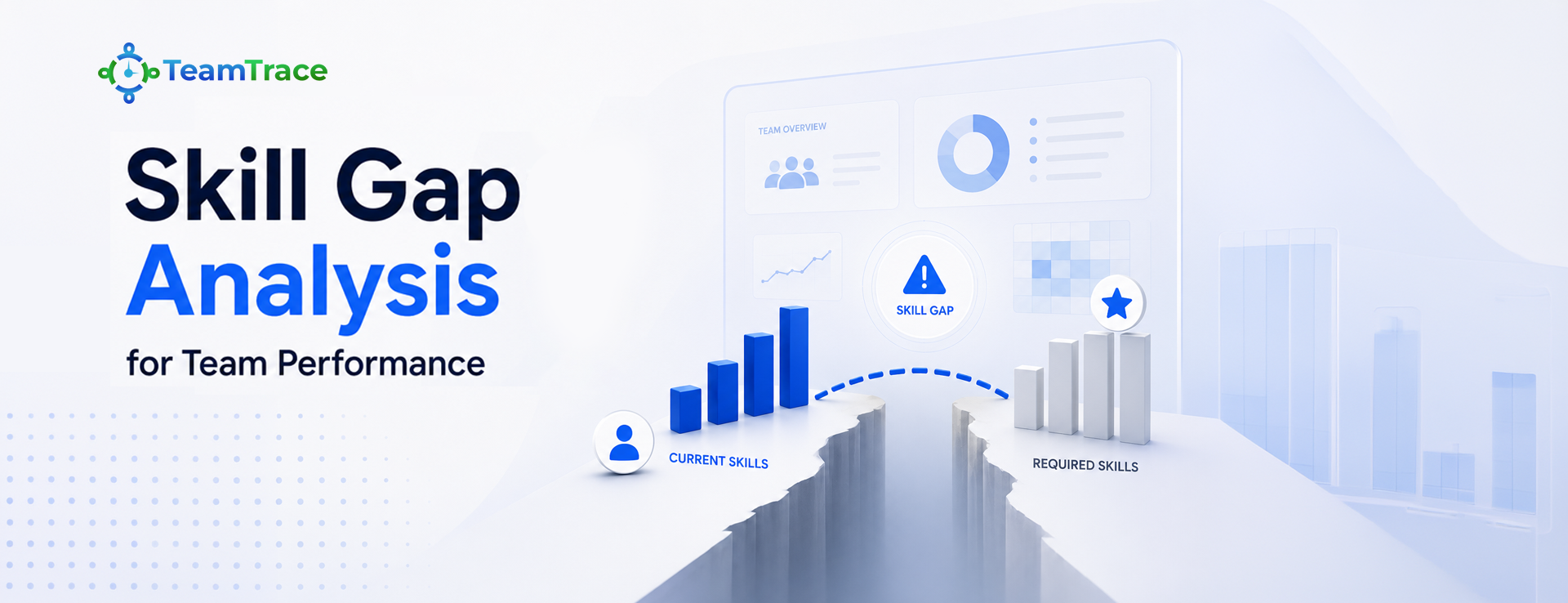
A skill gap analysis is a structured process that compares the skills your team currently has against the skills it needs to hit business goals — then pinpoints the difference. In plain terms, it answers one question: where are we short, and how short are we?
The output is a clear map where it displays the competencies each role requires on one side and your people’s actual abilities on the other. The space between them is your gap and your action plan.
Modern teams usually face four kinds of gaps:
Technical and digital gaps widen the fastest. The World Economic Forum estimates that 39% of workers’ core skills will be transformed or outdated between 2026 and 2030, so a skill that made someone a top performer two years ago may already be slipping behind.
Soft-skill gaps are the sneakiest, because they rarely show up on a résumé. A brilliant engineer who can’t brief a client, or a manager who dodges hard conversations, is a real gap you won’t catch in a spreadsheet.
The clearest signs are missed deadlines, inconsistent output quality, over-reliance on a few “go-to” people, stalled projects, and rising signs of employee burnout as your best performers absorb work others can’t handle.
Knowing how to identify skill gaps in employees starts with watching the work, not the annual review. When the same two names carry every critical task while others stall quietly, that lopsided load is a gap surfacing in plain sight.
Left unchecked, these signs compound. Deadlines slip, rework piles up, and your strongest people burn out from carrying everyone else, which is why catching the pattern early matters.
Skill gaps quietly drain performance and profit. They slow delivery, lower quality, inflate hiring and rework costs, and cap growth, turning a people issue into a P&L issue.
The numbers are stark. Korn Ferry projects the global skills shortage could cost businesses $8.5 trillion in unrealized annual revenue by 2030, and that damage starts small, with one missed deadline and one over-stretched employee at a time.
In India, this is a hiring reality too. Recent research found fewer than half of graduates are readily employable, so even when headcount is available, the right skills often aren’t, making internal skill-building non-negotiable for growing firms.
Define the skills each role needs, assess what your team actually has, compare the two to find the gaps, prioritize by business impact, and build a plan to close them.
Here’s how to conduct skill gap analysis without turning it into a six-week project:
You don’t have to start from scratch. A ready-made skill gap analysis template — a grid of roles, required skills, current ratings, and gap scores — makes this a repeatable, one-afternoon exercise.
Workforce productivity tools turn a skill gap analysis from a yearly opinion survey into a continuous, evidence-based picture. Instead of guessing who’s struggling, you see it in real work patterns.
Self-assessments are subjective, but work data isn’t. Time tracking software for teams and employee performance tracking shows how long tasks really take, where people get stuck, and where quality dips.
When you improve team performance with data instead of gut feel, you can tell whether a slow project is a skill, process, or workload problem, and fix the right one.
Platforms like productivity tracking fold time tracking and workforce performance analysis into one dashboard, so the data behind your skill gap analysis stays live and fair, because it measures the work, not the person.
Match the fix to the gap.
Upskilling usually wins on cost and morale. The World Economic Forum reports that 85% of employers plan to prioritise upskilling because developing someone you already trust beats a new hire still learning your business.
Picture a 60-person IT services firm in Bengaluru that keeps missing sprint deadlines. Leadership assumes the team is overloaded and prepares to hire, but a skill gap analysis tells a very different story.
The data shows two senior developers handling every complex task while four mid-level developers quietly avoid them — a classic technical gap. Productivity data confirms the mid-level engineers spend hours stuck on work the seniors finish quickly.
Instead of hiring, the firm pairs juniors with seniors, funds targeted training, and rebalances tasks. Within a quarter, delivery speeds up, the seniors stop burning out, and payroll holds flat — a better return than three new salaries could buy.
Review skills every quarter, tie them to live productivity data, and update your plan as roles, tools, and goals evolve.
When skill data updates continuously, you stop reacting to problems and start preventing them. This is how high-performing teams stay ahead.
You can’t fix what you can’t see. A skill gap analysis replaces guesswork with a clear, prioritized map of where your team is short, and the right data keeps that map accurate month after month.
If you want to improve team productivity with evidence instead of assumptions, the fastest place to start is live workforce data. TeamTrace brings productivity monitoring, time tracking, and performance insights into one place, so every skill gap analysis is backed by what your team actually does.
Book a free TeamTrace demo to see your team’s real skill and productivity picture, and turn your skill gaps into your next performance win.
The first pinpoints where your team’s skills fall short of what’s needed, while the second decides what training will close those gaps.
Ideally every quarter, or whenever roles, tools, or business goals shift significantly. Annual reviews move too slowly for modern teams.
Yes. Small teams feel every gap more sharply, so even a simple template-based review can stop one weak spot from stalling everyone.
A skill matrix template plus productivity monitoring tools like TeamTrace give you both the framework and the real work data to spot and track gaps.
No. It covers technical, digital, soft, and role-specific skills, since gaps in communication or leadership hurt performance just as much as missing hard skills.