
 Saswata


Your best people are quietly drowning while others coast, and by the time you notice, someone has already typed off their resignation. That silent imbalance is exactly what smart workload management is built to fix. It isn’t about squeezing more hours out of people but about matching the right work to the right person at the right capacity, so output climbs and stress falls at the same time.
In this guide, you’ll get five balancing methods you can apply this week, the tools that make them stick, and the mistakes that quietly sabotage most teams.
Every team has a fixed amount of capacity and a nearly unlimited amount of work. Workload management is the discipline that decides how that finite capacity gets spent, and getting it right is the difference between a team that ships and one that stalls. When work is balanced, deadlines hold, quality stays high, and people stay. When it isn’t, your most reliable employees absorb the overflow until they crack.
Strong team workload management also protects profit. Idle capacity is money you’ve already paid for but aren’t using, while overload is quality you’re quietly losing. Managers who treat balancing as a daily habit make calmer and faster decisions because they can finally see where the pressure actually sits.
Imbalance rarely announces itself. It shows up as a top performer who suddenly goes quiet in meetings, a project that slips “for no reason,” or a resignation that blinds you. Underneath, the mechanism is simple: work flows to whoever is most dependable, not to whoever has room. Over a few weeks, that concentration burns out your strongest players while others stay underused — and both are expensive.
Overloaded staff make more errors, miss deadlines, and eventually leave, taking hard-won knowledge with them. Underloaded staff disengage. Meanwhile, you keep paying full salaries for lopsided output. This is precisely why avoiding team burnout can’t live on a wellness poster. It has to be built into how work gets assigned in the first place.
These five methods form a repeatable balancing system that any manager can run.
Begin with a thorough workload analysis. List every active task, who owns it, how long it realistically takes, and when it’s due. Most managers are stunned to find one or two people carrying nearly half the load. This single view turns a vague feeling (“the team seems busy”) into a decision you can actually defend.
Next comes honest team capacity planning. Calculate the productive hours each person truly has after meetings, admin, and time off. Assigning against real capacity, instead of an idealized number, is what keeps your plan from collapsing in week two.
Not all work deserves equal urgency. Use simple task prioritization methods like separating urgent-and-important from merely noisy, so high-value work gets your team’s sharpest hours. When everything is labeled “priority,” nothing is, and your best people burn out on low-impact busywork.
With priorities set, apply proven workload distribution strategies and resource allocation techniques to spread work by capacity and skill. Move the overflow off your two busiest people and onto those with genuine room. Fair distribution isn’t softness but how you protect throughput.
Balancing is never “done.” Review weekly, watch for early overload signals, and shift work before someone breaks. By surfacing overload before it snowballs, strong team workload management lets you shift work before your best people break, turning burnout prevention into a built-in habit.
Spreadsheets work until your team grows past a handful of people — then they quietly lie to you, because a static grid can’t show real-time effort. That’s where dedicated workload balancing tools and workload optimization software earn their keep. The best platforms give you a live view of who’s working on what, how loaded each person is, and where capacity is sitting idle, so you can rebalance from data.
A platform like TeamTrace pulls productivity monitoring, time tracking, and project and resource management into one screen, so your workload management decisions rest on what’s actually happening. Instead of chasing people for updates, you see utilization, availability, and project burn rate in real time, and act before small pressures compound into missed deadlines. See how it works on the employee productivity and resource management side of the platform.
Even well-meaning managers sabotage their own balancing efforts. Watch for these five.
A packed calendar and a long task list feel like proof of work, but neither one tells you what actually got finished. Teams that measure busyness instead of output end up rewarding whoever looks the most frantic, not whoever moves the needle. Track deliverables and outcomes, not hours logged or messages sent.
When a deadline is tight, work flows to whoever always says yes, until that person is quietly carrying two jobs’ worth of tasks. It feels efficient in the short term, but it’s the fastest route to losing your best performer to a resignation letter. Spread the load deliberately, using real workload distribution strategies, instead of leaning on the same two or three names every time.
An eight-hour day looks great on paper until you subtract meetings, context-switching, admin, and interruptions, and maybe five productive hours remain. Managers who plan against the theoretical 40-hour week are setting their team up to miss deadlines before the sprint even starts. Real team capacity planning starts with actual available hours, not calendar math.
A single reshuffle might solve this week’s imbalance, but new projects, sick days, and shifting deadlines undo it within days. Workload balancing isn’t a project with an end date. Rather, it’s a weekly habit, like checking your bank balance. Skip it for a month and you’re back to the same overloaded few carrying everyone else’s slack.
“How long will this actually take?” is the most skipped question in task assignments and the most expensive one to skip. When estimates are guesses instead of grounded numbers, every schedule built on top of them is a guess too. Ask the person doing the work how long it will realistically take, then build your workload management plan around real numbers, not hope.
Fix these five, and half your balancing problems vanish before you reach for any advanced method.
A short list of KPIs tells you almost everything you need:
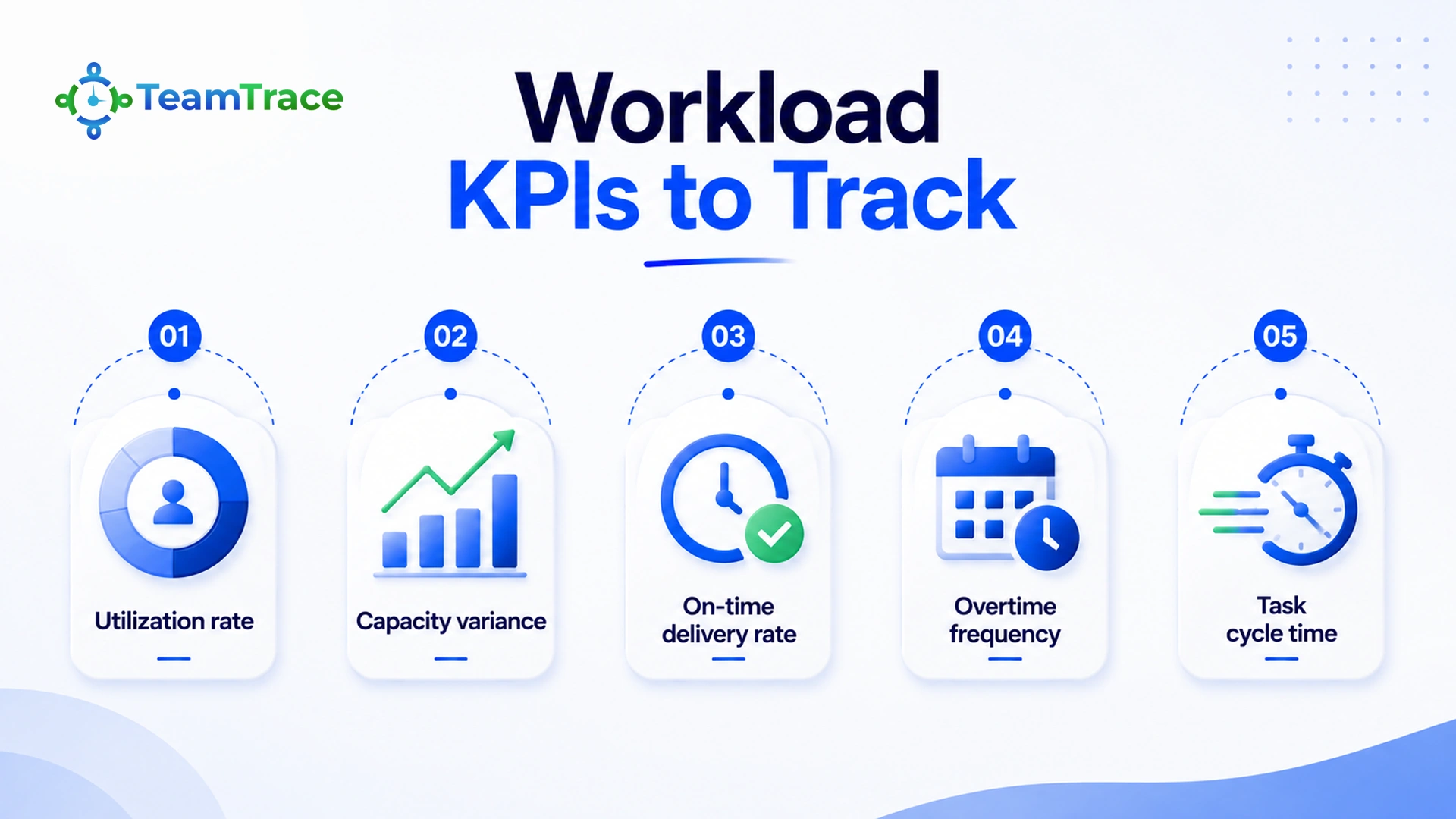
Track these weekly, and the numbers will flag imbalance long before a resignation ever does.
Great teams are built on balance. At its core, workload management is simply the practice of seeing the work clearly and matching it to real capacity, week after week. Start with a workload analysis, plan against true capacity, prioritize ruthlessly, distribute deliberately, and rebalance to protect your people. Do that consistently, and you’ll ship more, lose fewer people, and stop mistaking motion for progress.
The managers who win aren’t the ones who push their teams hardest. They’re the ones who balance the load smartest. Ready to see your team’s real workload in a single view? Start a free 7-day TeamTrace trial.
Workload management is the process of planning, distributing, and balancing work across a team, so no one is overloaded or underused. It combines workload analysis, team capacity planning, and prioritization to match work to the real available capacity.
Balance workload by running a workload analysis, mapping true capacity, prioritizing high-value tasks, distributing work by skill and availability, then reviewing weekly. Software that surfaces real-time utilization makes each rebalance far faster and fairer.
Dedicated workload balancing tools and workload optimization software — like TeamTrace — give managers a live view of who’s loaded, who has room, and where deadlines are at risk, replacing guesswork with hard data.